
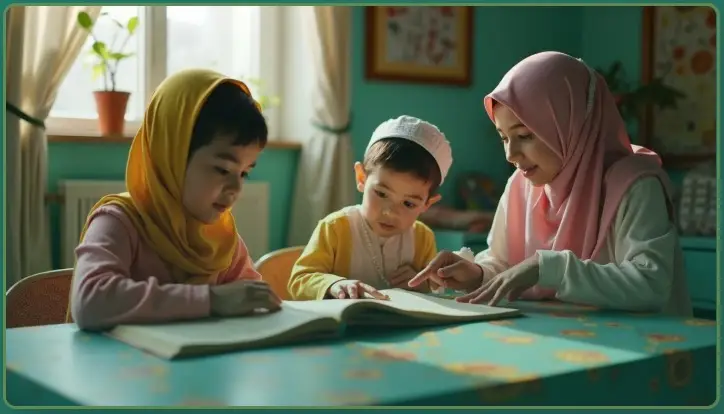
One very common question from Muslim parents is about the best age at which a child should start learning the Quran. To answer this question, one has to consider aspects of child development, Islamic tradition, and creating an appropriate learning environment for the children.
At Quraan Academy UK, we have assisted a significant number of children throughout the United Kingdom in starting their Quranic education. Based on practical experience and advice from Islamic scholarship, this paper provides a detailed guide intended to assist a decision on a child’s Quranic education.
The Golden Age : 4–6 Years
Researches on child development and Islamic tradition coincide on specifying ages 4–6 as an auspicious period to start formal Quranic education. The interval is often referred to as the “golden age” because of the reasons that follow:
- Brain plasticity: The young brain is more open to foreign languages and phonetic stimuli at this stage.
-Memory formation: Early memories become robust and enduring.
Natural Curiosity: Children have a high degree of readiness to learn through imitation and exploration. - Reduced distractions: Before the demands of formal schooling, there is comparatively greater opportunity for Islamic education.
Age-by-Age Quran Learning Guide
Ages 2-3: Laying Foundations
In this early stage, more focus should be directed to creating a supportive Islamic setting:
- Play recording of Quran recitation during routine activities
- Teach simple supplications associated with eating and sleep.
- Introduce the Arabic alphabet, using songs and multicolored flashcards
- Allow observation of parents praying and reading the Quran
Ages 4–5: Structured Introduction
This age group is suitable for an initial engagement with Noorani Qaida or basic Tajweed:
- Individual daily practice for 15–20 minutes
Prioritize recognition and pronunciation of Arabic letters. - Memorization of short Surahs (Al-Fatiha, Al-Ikhlas, Al-Falaq, An-Nas) should be initiated
- Utilize interactive, play-based instructional methods
Ages 6–8: Skill development
With greater cognitive maturity, learners are able to engage in more structured study:
- Finish Noorani Qaida and start reading the Quran
- Learn basic Tajweed rules
- Extend memorization to Juz Amma – the 30th portion
- Session times are 30–45 minutes long
Ages 9–12: Building Understanding
Pre-adolescents may be given more responsibility for their learning: - Consider an official Hifz (memorization) program, if desired.
- Advance Tajweed and Qira’at study
-Develop understanding of meaning (basic Tafseer)
Develop individual reading and revision practices
Indicators of Readiness
Children develop at their own pace. Readiness may be gauged by the following:
- Ability to sit and stay on-task for 10–15 minutes
Demonstrated interest in books, letters, or adult activities
- Ability to follow simple instructions
- To enjoy listening to the Quran or Islamic nasheeds,
- Question about Allah, Islam or prayer
Benefits of an Early Quran Education
Early initiation of Quranic study yields many benefits in later life:
A Strong Spiritual Foundation: The connection becomes deep and intrinsic through the Quran.
- Improved Arabic pronunciation: Early mastery of Makharij is facilitated.
Improved capacity for memory: Early memorization supports wider learning processes.
Character Development: Quranic values influence personal development. - Academic benefits: Memorization of the Quran is associated with improvement in cognitive capabilities.
Parental Concerns and Responses
“Is my child too young?”
Exposure to Quranic content can be useful from as young as three, provided the methods are appropriate for them-teaching through singing and playing, repetition rather than formal instruction. “Will this overwhelm my child with schooling? Short, regular sessions-15-30 minutes daily-can raise general learning capacity without causing burnout. Online Quran teaching can offer the flexibility needed for balancing several commitments. “What if we start late? It is still possible at later ages; older children and adults can become proficient readers and Huffaz. The Prophetic companions pursued Islam and learned Quran at different ages. Guidelines for successful Quran learning – Consistency: Brief daily sessions are preferable to infrequent, longer ones. – Fun: include games, rewards, and positive reinforcement Exemplary behavior: Show interest in Quranic reading and love toward it. Qualified instruction Engage a patient, experienced teacher • Learning space: a quiet and comfortable setting to support focus -Milestone celebration: recognition of achievements to maintain motivation Frequently Asked Questions How long will it take a child to learn the reading of the Quran? With regular daily practice, most children aged 5–7 can complete Noorani Qaida and start reading the Quran within 6–12 months. Results may vary depending on age, learning type, and frequency of practice. Should boys and girls start at the same age? Yes, both genders should start Quranic education at approximately the same age since seeking Islamic knowledge is a duty and obligation on every Muslim, be it male or female. Do online classes work for young children? Yes, contemporary online Quran programs utilize interactive tools, engaging visuals, and personalized attention that may be quite effective with young learners and sometimes more so than traditional settings.